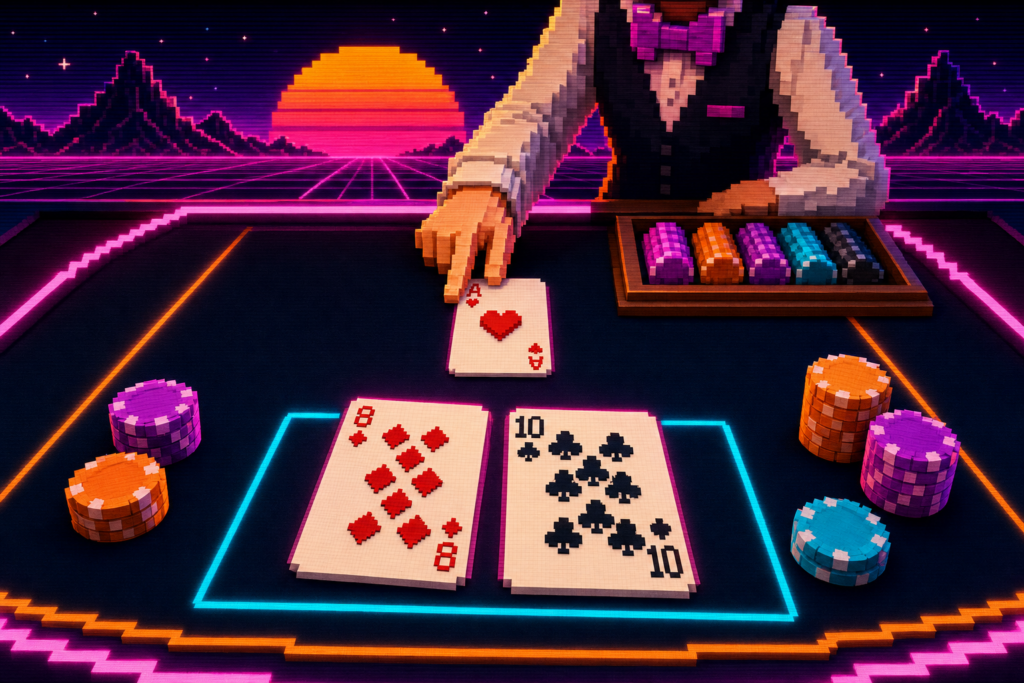
How to Play Blackjack: Rules and Step-by-Step Guide
Blackjack is the card game where you play against the dealer, not the other people at the table, and the goal is simpler than most newcomers expect: finish with a hand worth more than the dealer’s without going over 21. That is the whole game in one sentence. Everything else is timing and decisions. This guide walks you through the blackjack rules, the card values and every move you can make, and once it clicks you can practise it for free on the trainer table above before you ever risk a penny.
If you have never sat at a table, do not worry about looking lost. The blackjack rules fit on a napkin, and there are only a handful of choices per hand. Read this once, deal yourself a few practice rounds, and you will hold your own at any table in the country.
The goal of the game: beat the dealer, not 21
Beginners often think the aim is to hit exactly 21. It is not. The aim is to beat the dealer’s hand. You can win with a total of 17 if the dealer busts, and you can lose with 20 if the dealer draws to 21. Keep that framing and the strategy later on will make far more sense.
You win a hand in one of three ways: your total is higher than the dealer’s without exceeding 21; the dealer draws too many cards and goes bust while you are still standing; or you are dealt a natural blackjack that the dealer does not match. You lose if you go over 21 (a bust) or the dealer simply out-totals you. If both sides finish level, the hand is a tie, and your stake comes back.
Because the dealer plays last and to a fixed rule, a good chunk of blackjack is reading the dealer’s up-card and deciding whether to push for a bigger total or let the dealer take the risk of busting. That single idea is the seed of basic strategy, which we cover in depth on its own page.
Card values in blackjack
The card values are quick to learn and never change:
- Number cards (2 to 10) are worth their face value. A seven is seven, a ten is ten.
- Face cards (Jack, Queen, King) are each worth 10.
- Aces are worth either 1 or 11, whichever helps your hand more. The ace is the flexible card that makes blackjack interesting.
Suits do not matter in blackjack. A heart and a spade of the same rank are identical for scoring. What matters is the total, and how you count the ace.
Hard hands and soft hands
A hand is called soft when it contains an ace being counted as 11, because you cannot bust on the next card, the ace can quietly drop to 1 if you overshoot. An Ace-6 is a soft 17. A hand is hard when there is no ace, or the ace has to count as 1 to avoid busting. A 10-7 is a hard 17, and so is Ace-6-10. The distinction matters a lot once you start playing correctly, because a soft 17 is played very differently from a hard 17.
What is a natural blackjack?
A natural, or “blackjack”, is an ace paired with any ten-value card as your first two cards, 21 on the deal. It beats every other 21 that takes three or more cards, and it usually pays more than an ordinary win. At a fair table the payout is 3 to 2, so a £10 blackjack returns £15 in winnings. Watch out for tables paying 6 to 5 instead; that shorter payout quietly raises the house edge and is worth avoiding.
A step-by-step guide to how a hand of blackjack is played
Here is a full round from start to finish so you know exactly what happens and when it is your turn to act.
- Place your bet. Before any cards come out, you put your chips in the betting box. This is the only wager you are committed to; later moves can increase it, but you never bet less than this.
- The deal. You receive two cards face up. The dealer takes two as well, one face up (the up-card) and one face down (the hole card). The dealer’s up-card is the single most useful piece of information you have.
- Check for blackjack. If you or the dealer has a natural, it is settled immediately. If you have one and the dealer does not, you are paid straight away.
- Your decisions. Now you act on your hand, hit, stand, double down, split or, at some tables, surrender. You can take as many cards as you like until you either stand or bust. We break each of these down below.
- The dealer’s turn. The dealer reveals the hole card and draws to a fixed rule, usually hitting until reaching at least 17. The dealer has no choices to make; the house rules decide everything.
- The payout. Hands are compared. Winners are paid, losers lose their stake, and ties push. The cards are cleared and the next round begins.
That loop repeats hand after hand. The only part that takes any thought is step four, so let us go through your options properly.
Your moves: hit, stand, double down, split and surrender
Every decision in blackjack comes down to a small menu of moves. Master these five and you know how to play blackjack at any casino, online or in person.
Hit
To hit is to ask for another card. You hit when your total is low enough that the extra card is likely to help more than hurt, say you are holding 12 against a dealer’s 10. You can keep hitting as long as you want, but the moment your total passes 21 you have bust and the hand is lost, even if the dealer later busts too. In a live game you signal a hit by tapping the felt; online you simply press the Hit button.
Stand
To stand is to keep your current total and pass the action to the dealer. You stand when you judge that drawing again risks busting more than it gains, for example, sitting on a hard 17, or on 13 when the dealer shows a weak card like a 5 or 6 and looks likely to bust. Standing is a decision, not a default; standing on the wrong total gives away money over time.
Double down
Doubling down lets you double your original bet in exchange for exactly one more card, after which you must stand. It is a move for strong starting hands, most often a two-card total of 10 or 11, where a single ten-value card gives you a monster. The trade-off is real: you commit twice the money and lock yourself into one card, so it only pays off when the maths is in your favour. The strategy chart shows exactly when.
Split pairs
If your first two cards are a pair (two eights, two aces, two sevens) you can split them into two separate hands, each getting a second card and its own bet equal to your first. Splitting turns one awkward hand into two live ones. The classic examples: always split aces and eights, never split tens or fives. A pair of tens is already a 20 and does not need touching, while a pair of fives is better played as a hard 10 you can double.
Surrender
Some tables offer surrender, which lets you fold a bad hand after the deal and get half your stake back rather than play it out. It is the rarest move and only correct in a few spots, a hard 16 against a dealer’s 9, 10 or ace is the textbook case. If the table offers it and the situation fits, taking back half beats losing the lot.
Insurance and the dealer’s ace
When the dealer’s up-card is an ace, you will be offered insurance. It is a side bet, up to half your original stake, that the dealer has a ten in the hole for a blackjack. If they do, insurance pays 2 to 1 and roughly offsets your main loss; if they do not, you lose the insurance and play on.
Here is the honest verdict, and it holds regardless of how confident you feel: insurance is a losing bet in the long run for anyone who is not tracking the deck. The odds of that hole card being a ten do not justify the price. Unless you are an experienced card counter with a genuine read on the remaining cards, the disciplined move is to decline insurance every single time. Treat it as a trap dressed up as a safety net.
Dealer rules: why the house always plays the same way
The dealer does not get to make decisions, and understanding their fixed rule is half of playing well. In the standard game the dealer must keep drawing until reaching a total of 17 or more, then stand. The only wrinkle is soft 17 (an ace-six): at some tables the dealer stands on it, at others the dealer hits. “Dealer stands on soft 17” is slightly better for you, and it is the rule the trainer table and our strategy chart are built around.
Because the dealer’s behaviour is scripted, you can plan against it. When the dealer shows a weak card, a 4, 5 or 6, they are more likely to bust, so you can afford to stand on modest totals and let them take the risk. When they show a strong card like a 9, 10 or ace, you often need to push for a bigger total yourself. That read is the backbone of every strategy decision.
House edge, RTP and what the odds really mean
No honest guide will tell you blackjack can be beaten with certainty, it cannot, and anyone promising a guaranteed system is selling something. Even card counting, the one technique that genuinely shifts the odds, only earns a disciplined player a tiny edge and cannot beat the game outright. What blackjack does offer is one of the lowest house edges of any casino game when you play well. With correct basic strategy, the house edge on a good table sits below one percent, which is far friendlier than roulette or most slots.
Play badly, though, and that edge balloons. Taking insurance, standing on soft hands, refusing to split aces, each mistake hands the house more of your money. The odds of winning any single hand hover a little under half; the difference between a winning session and a losing one is almost entirely about making the correct decision on borderline hands, hand after hand. That is why practice matters more than luck.
Playing blackjack online versus at a live table
How to play blackjack does not change between a felt table and your phone: the rules are identical, but the experience differs. Online you get software-dealt games that run quickly and let you play at your own pace, plus live-dealer tables streamed from a studio with a real croupier. In a bricks-and-mortar casino you get the atmosphere, the etiquette and hand signals, and a slower rhythm.
For learning, online is unbeatable. You can drill hundreds of hands in the time a live table deals a dozen, with no pressure and no tips to worry about. Start on the free blackjack trainer here, lock in the correct moves, then decide where you want to play for real. When you are ready to play for money, our guide to the best blackjack casinos covers how to pick a licensed, fair site.
Common beginner mistakes to avoid
A few errors show up again and again at the tables, and every one of them costs money over time:
- Taking insurance. It looks prudent and it is not. Decline it.
- Copying the dealer’s rule. Standing on every 17 or always hitting to 17 ignores what the dealer’s up-card is telling you.
- Not splitting aces and eights. These two splits are almost always correct, yet nervous players sit on the pair.
- Playing 6-to-5 tables. A blackjack that pays 6 to 5 instead of 3 to 2 adds about 1.4% to the house edge — several times the entire edge of a good table. Check the felt before you sit.
- Chasing losses. Raising your stake to win back a bad run is how a small loss becomes a large one. Set a limit before you start and stick to it.
Practise for free before you play for real
Knowing how to play blackjack on paper is the easy part; making the right move under a little pressure is where it counts. The trainer table at the top of this page deals a genuine six-deck game with the same rules our strategy chart assumes, so the moves you learn here transfer directly. Play a few hundred hands, watch how the correct decisions feel counter-intuitive at first and then obvious, and only move to real money once the basics are second nature.
When you do decide to play for real, treat it as entertainment with a budget you are comfortable losing, not a way to make money. Blackjack rewards discipline and punishes chasing. Learn the game properly, keep your stakes sensible, and it becomes one of the most enjoyable games in the casino.
18+ only. Gambling should be fun, not a way to make money. Set a budget and stick to it. If it stops being fun, or you are worried about your gambling, free confidential support is available at BeGambleAware.org or on the National Gambling Helpline. Please play responsibly.
How to play blackjack, frequently asked questions
What is the main objective when playing blackjack?
The objective is to beat the dealer’s hand, not to hit exactly 21. You win by finishing with a total higher than the dealer’s without going over 21, or by staying in the hand while the dealer busts. Getting closest to 21 only matters relative to what the dealer ends up with.
How are the card values counted in blackjack?
Number cards count as their face value, and Jacks, Queens and Kings are each worth 10. An ace is worth either 1 or 11, whichever gives you the better hand, which is what makes it the most useful card in the deck. Suits have no effect on scoring.
What is the difference between ‘hit’ and ‘stand’?
To hit is to take another card, adding to your total and risking a bust if you go over 21. To stand is to keep your current total and pass the turn to the dealer. You hit when your hand is likely to improve and stand when drawing again is more likely to bust you than help.
When should I consider splitting pairs?
Split when your first two cards are a matching pair and separating them gives you two stronger hands. The reliable rules are to always split aces and eights, and never split tens or fives. Other pairs depend on the dealer’s up-card, which the basic strategy chart lays out precisely.
What does it mean to ‘double down’ in blackjack?
Doubling down means doubling your original bet in return for exactly one more card, after which you must stand. It is used on strong two-card totals, most often a 10 or 11, where a single ten-value card gives you a commanding hand. It rewards you when the odds favour one more card and no more.
What is a ‘push’ in blackjack?
A push is a tie: you and the dealer finish with the same total, so neither side wins. Your original stake is returned to you and nothing is paid out or lost. It is a neutral result that simply carries you into the next hand.
Is insurance a good bet to take?
For almost everyone, no. Insurance is a side bet that the dealer’s ace hides a ten, and its odds are worse than the payout, so it loses money over time. Unless you are an experienced card counter, the correct move is to decline insurance every time it is offered.
Is it legal to play online blackjack for real money in the UK?
Yes. Playing online blackjack for real money is legal in the United Kingdom, provided the operator holds a licence from the UK Gambling Commission. You must be 18 or over, and you should only ever play at a properly licensed site.
How can I check if an online casino is safe and regulated for UK players?
Look for the operator’s UK Gambling Commission licence number, usually shown in the website footer, and confirm it on the Commission’s public register. A regulated site will also carry responsible-gambling links and clear terms. Our guide to the best blackjack casinos explains what to check in detail.
What is the difference between a hard hand and a soft hand?
A soft hand contains an ace counted as 11, so you cannot bust on the next card, the ace can drop to 1 if needed. A hard hand has no ace, or an ace that must count as 1. The two are played differently, because a soft total gives you a free swing at improving it.
Does the dealer have to follow set rules?
Yes. The dealer makes no choices and must draw until reaching at least 17, then stand. At some tables the dealer also hits a soft 17; a table where the dealer stands on soft 17 is marginally better for the player.
What happens if both the player and the dealer bust?
If you bust first by going over 21, the hand is lost immediately, it does not matter what the dealer does afterwards. Because players always act before the dealer, there is no scenario where you are refunded for a shared bust. This is a big part of why the house holds an edge.
How much does a blackjack pay out?
At a fair table, a natural blackjack pays 3 to 2, so a £10 bet returns £15 in winnings plus your stake. Some tables pay only 6 to 5, which returns less and raises the house edge, so it is worth checking the payout before you sit down. An ordinary winning hand pays even money.
Can I learn to play blackjack for free before betting real money?
Absolutely, and you should. The free trainer table on this site deals a full six-deck game with play chips only, so you can practise every decision with nothing at stake. Drilling the correct moves for free is the fastest way to be ready for a real table.
What support is available if I am concerned about my gambling in the UK?
Free and confidential help is available around the clock through the National Gambling Helpline and BeGambleAware.org, and tools like GamStop let you self-exclude from licensed UK sites. If gambling stops being fun or starts causing worry, reaching out early makes a real difference. Support is always free and always confidential.