Blackjack Strategy: Basic Chart and Tips to Cut the House Edge
Blackjack strategy — basic strategy above all — is the single biggest thing separating a player who loses steadily from one who barely gives the house an edge at all. It is not a betting trick or a secret system, it is simply the mathematically correct move for every hand you can be dealt, worked out long ago by running the numbers on millions of hands. Learn it, and you make the right decision automatically instead of guessing. This is the best blackjack strategy there is, it is free, and you can drill it on the trainer table above until it becomes second nature.
There are no guarantees in blackjack; the house still holds a small edge even against flawless play. But basic strategy shrinks that edge to well under one percent on a good table, which is about as fair a game as a casino offers. Everything below builds on that foundation, from the core chart to the fifteen adjustments that tighten your play.
What blackjack basic strategy actually is
Basic strategy is a complete set of instructions telling you whether to hit, stand, double or split for every combination of your hand and the dealer’s up-card. It was derived by calculating the expected value of each option in each situation and keeping only the one that loses the least or wins the most over time. There is no judgement involved once you know it, the chart already did the thinking.
The key thing to understand is that your two cards and the dealer’s one visible card are all the information the strategy needs. It does not care how you feel about the hand or whether you are on a losing streak. Two players dealt the same hand against the same up-card should always make the same move, every time. That consistency is exactly what makes it work.
If you are still learning the mechanics, hitting, standing, splitting and so on, read our guide on how to play blackjack first, then come back here to learn how to play those moves correctly.
The basic strategy chart: how to play every hand correctly
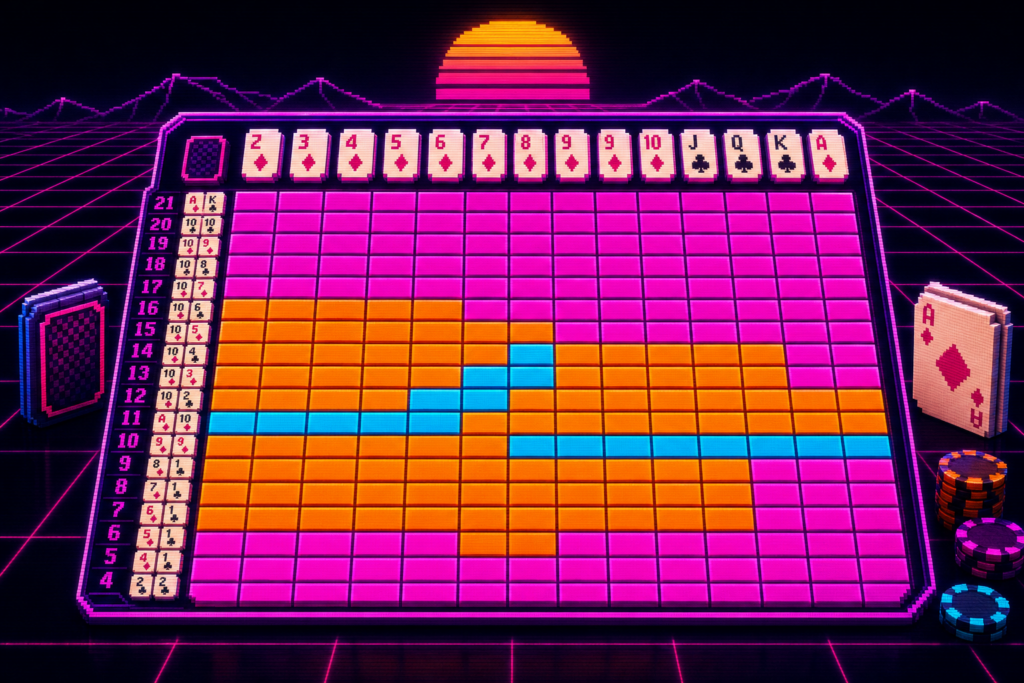
The chart below covers hard totals against every dealer up-card, using the rule set our trainer table and the interactive chart at the top of the site are built on: six decks, dealer stands on soft 17, doubling allowed after a split, and late surrender available. Read down the left column for your total and across the top for the dealer’s up-card, and the cell tells you the correct move.
| You | 2 | 3 | 4 | 5 | 6 | 7 | 8 | 9 | 10 | A |
|---|---|---|---|---|---|---|---|---|---|---|
| 8 or less | H | H | H | H | H | H | H | H | H | H |
| 9 | H | D | D | D | D | H | H | H | H | H |
| 10 | D | D | D | D | D | D | D | D | H | H |
| 11 | D | D | D | D | D | D | D | D | D | H |
| 12 | H | H | S | S | S | H | H | H | H | H |
| 13 | S | S | S | S | S | H | H | H | H | H |
| 14 | S | S | S | S | S | H | H | H | H | H |
| 15 | S | S | S | S | S | H | H | H | R | H |
| 16 | S | S | S | S | S | H | H | R | R | R |
| 17+ | S | S | S | S | S | S | S | S | S | S |
Key: H = hit, S = stand, D = double down (hit if doubling is not allowed), R = surrender (hit if surrender is not offered). The interactive colour-coded chart at the top of the site shows the same moves and lets you quiz yourself hand by hand.
Reading the hard-totals chart
A few patterns jump out once you look at it. You always stand on 17 and above and always hit 8 or below, those are the easy ends. The interesting region is 12 to 16, the “stiff” hands, where the right move depends entirely on the dealer’s up-card. Against a weak dealer card (2 through 6) you tend to stand and let the dealer risk busting; against a strong one (7 through ace) you hit and try to improve, because the dealer is likely to make a good total. Learn that single principle and half the chart follows naturally.
Soft hands: playing your aces correctly
A soft hand contains an ace counted as 11, and the flexibility of that ace changes everything. Because you cannot bust by taking one more card, the ace simply drops to 1 if you overshoot, you can afford to be aggressive. Soft hands are where a lot of casual players leak money, standing far too early.
- Soft 13 to 15 (Ace-2 to Ace-4): hit against most up-cards, and double against a dealer’s 5 or 6 where they are weakest.
- Soft 16 to 18 (Ace-5 to Ace-7): double against the dealer’s 4, 5 and 6. Soft 18 is the trap hand, stand against 2 through 8, but hit against 9, 10 and ace, because 18 is not the strong total it looks like against a strong dealer card.
- Soft 19 and 20 (Ace-8, Ace-9): stand. These are already winning totals; leave them alone.
When to split pairs
Splitting turns a pair into two separate hands, each with its own bet. Done right it wins you more money on strong pairs and rescues you from weak ones. Done on autopilot it burns chips. The reliable rules:
- Always split aces and eights. Two aces played as one hand is a stiff 12; split, and each ace starts a hand that can hit blackjack. A pair of eights is a wretched 16, but two hands starting on 8 are far more promising.
- Never split tens or fives. A pair of tens is a 20, one of the best hands you can hold, so do not break it. A pair of fives is a hard 10 you should be doubling, not splitting.
- Split twos, threes, sixes, sevens and nines against weak dealer cards, where the dealer is likely to bust and two live hands beat one. Sit on nines against a dealer’s 7, though, your 18 already beats their likely 17.
When to double down
Doubling down doubles your bet for exactly one more card, so you want it when a single card is very likely to give you a strong total and the dealer is vulnerable. The bread-and-butter doubles are a hard 10 or 11 against almost any dealer up-card, and a hard 9 against the dealer’s 3 through 6. Add the soft doubles above and you have covered nearly every profitable double there is. The rule of thumb: double when you are strong and the dealer is weak, never as a hopeful punt on a bad hand.
Fifteen tips for better blackjack play
Beyond the chart, a handful of habits separate solid players from the rest. Here are fifteen tips that pay for themselves:
- Learn the hard-totals chart first, it covers the most hands you will face.
- Never take insurance unless you are counting cards; it is a losing side bet.
- Always split aces and eights, no exceptions worth remembering.
- Never split tens; a 20 is too good to break up.
- Stand on hard 17 and above, always.
- Hit stiff hands (12, 16) against a dealer’s 7 or higher.
- Stand on stiff hands against a dealer’s 4, 5 or 6.
- Double a hard 11 against anything but an ace.
- Avoid tables that pay 6 to 5 on blackjack, find the 3-to-2 games.
- Prefer tables where the dealer stands on soft 17.
- Never chase losses by raising your stake after a bad run.
- Set a session budget before you sit down and treat it as spent.
- Ignore other players’ decisions; their hands do not affect yours.
- Practise on the free trainer until the chart is automatic.
- Play sober and stop when you stop enjoying it.
How to learn basic strategy so it sticks
Memorising a grid sounds tedious, but you do not learn it by staring at it, you learn it by playing. Start with the hard totals, since they come up most often, then layer in the soft hands and splits. Deal yourself hands on the free blackjack trainer, make your move, and check it against the chart. Get one wrong and you will remember it far better than any flashcard. A few sessions of a couple of hundred hands each and the correct plays stop feeling like recall and start feeling like reflex.
The interactive chart at the top of this site can quiz you directly: it shows a hand, you pick a move, and it tells you whether the maths agrees. That feedback loop is the fastest route from “I sort of know it” to “I never have to think about it”.
Does strategy change between blackjack variants?
The core chart holds up remarkably well across the game’s different flavours, but the rules of the specific table shift a few cells. A game where the dealer hits soft 17, or one with fewer decks, or one that bans doubling after a split, each nudges the correct play in a handful of spots. Learn the standard chart first, it is right the overwhelming majority of the time, then adjust for the table in front of you. Our guides to the blackjack variants cover how each rule change affects your best move, from single-deck blackjack to Spanish 21.
Basic strategy versus card counting
Basic strategy tells you the best move for the hand in front of you; card counting tells you when the odds across the whole shoe have swung in your favour so you can bet more. They are different skills, and basic strategy is the prerequisite, counting is worthless if you are not already playing every hand correctly. Almost everyone should stop at basic strategy, which delivers most of the benefit for a fraction of the effort. If you are curious about the next level, our page on card counting in blackjack explains how it works and why it is far harder in practice than films make it look.
Where to put your strategy into practice
Once the chart is second nature, your blackjack strategy travels with you and these tips hold at any table. The free trainer is the place to build the habit at no risk, and when you want to play for real money our guide to the best blackjack casinos covers how to find a licensed table with fair rules and a proper 3-to-2 payout, the kind of table where good strategy is actually rewarded.
18+ only. Basic strategy lowers the house edge but never removes it; no strategy can guarantee a win. Gambling should be entertainment, not income. Set a budget, play responsibly, and if you are worried about your gambling, free confidential support is available at BeGambleAware.org and on the National Gambling Helpline.
Blackjack strategy, frequently asked questions
How do I learn blackjack basic strategy?
Start with the hard-totals chart, since those hands come up most, then add soft hands and pair splits. The fastest way to learn it is by playing rather than reading: deal hands on a free trainer, make your move, and check it against the chart until the correct plays become automatic. A few focused sessions are usually enough for the basics to stick.
How do you win at blackjack with basic strategy?
Basic strategy does not let you “win” outright, the house keeps a small edge even against perfect play. What it does is minimise that edge to well under one percent, so your money lasts far longer and your results depend far less on bad decisions. You win more sessions by never giving away value on borderline hands.
How do you play 21?
“21” is just another name for blackjack. You aim to beat the dealer by getting a hand total closer to 21 without going over, choosing to hit, stand, double or split on each hand. Our guide on how to play blackjack walks through every rule and move for complete beginners.
How do you play black jack for beginners?
Learn the goal first, beat the dealer without busting past 21, then the card values and the five moves: hit, stand, double, split and surrender. Once the mechanics are clear, basic strategy tells you which move to make in each situation. Practising on a free trainer before betting real money is strongly recommended.
What are the odds of winning blackjack?
You win a little under half of all hands, lose slightly more, and tie the rest, which is why the house holds an edge. With correct basic strategy that edge is under one percent on a good table, far better than most casino games. No strategy changes the fact that individual hands remain a matter of chance.
How do you always win at blackjack?
You cannot. There is no strategy, system or trick that guarantees a win at blackjack, and anyone claiming otherwise is misleading you. Basic strategy is the best you can do: it gives you the lowest possible house edge, but the game always retains an element of chance. Play for entertainment, not as a way to make money.
What is card counting?
Card counting is a technique for tracking the ratio of high to low cards left in the shoe, so a player can raise their bet when the remaining cards favour them. It is legal but casinos may ask counters to leave, and it is much harder to do profitably than films suggest. It only helps a player who already plays perfect basic strategy.
How do you deal blackjack at home?
The dealer gives each player two cards face up and takes two for themselves, one up, one down, then players act in turn before the dealer draws to at least 17. At home you can use one or more standard decks and pay blackjacks at 3 to 2. Keeping to the standard dealer rule makes home games fair and easy to follow.
How do you play blackjack at home?
You need a deck or two of cards, chips or counters, and someone to deal. Follow the same rules as a casino: the dealer draws to 17, blackjacks pay 3 to 2, and players decide to hit, stand, double or split. Rotating the dealer role between hands keeps a friendly game fair.
Should I ever deviate from the basic strategy chart?
Not unless you are counting cards and the count justifies it. For every other player, following the chart on every hand is the correct approach, and deviating on a hunch simply gives the house more of an edge. The chart already accounts for the odds better than any in-the-moment feeling can.
Does basic strategy work for online blackjack?
Yes. Basic strategy applies identically to online and live blackjack, since the rules and card values are the same. The main thing to check is the specific table rules, deck count, soft-17 rule and payout, and adjust the handful of cells those affect. Online play is also the ideal place to drill the chart with no pressure.
Is it worth learning strategy if I only play for fun?
Definitely, because playing correctly makes your budget last far longer and the game more enjoyable. Even for a casual player, basic strategy is the difference between an evening’s entertainment and burning through your chips in twenty minutes. It costs nothing to learn and the free trainer makes it painless.
How long does it take to memorise basic strategy?
Most people get the hard totals down in a session or two of active practice, with soft hands and splits following soon after. Because you learn by playing rather than rote memorising, it comes faster than it looks. A week of short, regular trainer sessions is usually plenty to reach automatic recall.
Does basic strategy change between blackjack variants?
Only slightly. The core chart is correct the large majority of the time, and specific rules, dealer hitting soft 17, fewer decks, no double after split, shift only a handful of cells. Learn the standard chart first, then make small adjustments for the particular table you are playing.
Is basic strategy the same as counting cards?
No. Basic strategy tells you the best play for the current hand; card counting tracks the shoe to tell you when to bet more. Basic strategy is essential for everyone and easy to learn, while counting is an advanced skill that only helps once your basic play is already perfect.